
Robotic kidney cancer surgery is an advanced urological oncology surgery method performed using minimally invasive (closed) techniques with the da Vinci robotic surgery system. Thanks to the robotic system, the surgeon can work with millimeter precision with high-resolution three-dimensional imaging, tremor filtration and articulated instruments. This precise approach ensures that kidney cancer tissue is removed in accordance with oncological principles while supporting the preservation of surrounding healthy kidney tissue and surrounding organs.
Robotic kidney cancer surgery in Bursa is a modern treatment option, especially for advanced surgical procedures such as radical nephrectomy (removal of the entire kidney) and partial nephrectomy (tumor-focused partial kidney removal). This method provides advantages such as less bleeding, shorter hospital stay and faster recovery compared to open surgery.
Robotic kidney cancer surgery prices and surgical approach to be applied; The stage of the disease is determined by multidisciplinary evaluation after the examination, according to the location of the tumor, the general health status of the patient and the planned surgical technique. For detailed information and to make an appointment, you can contact us from the contact options below.
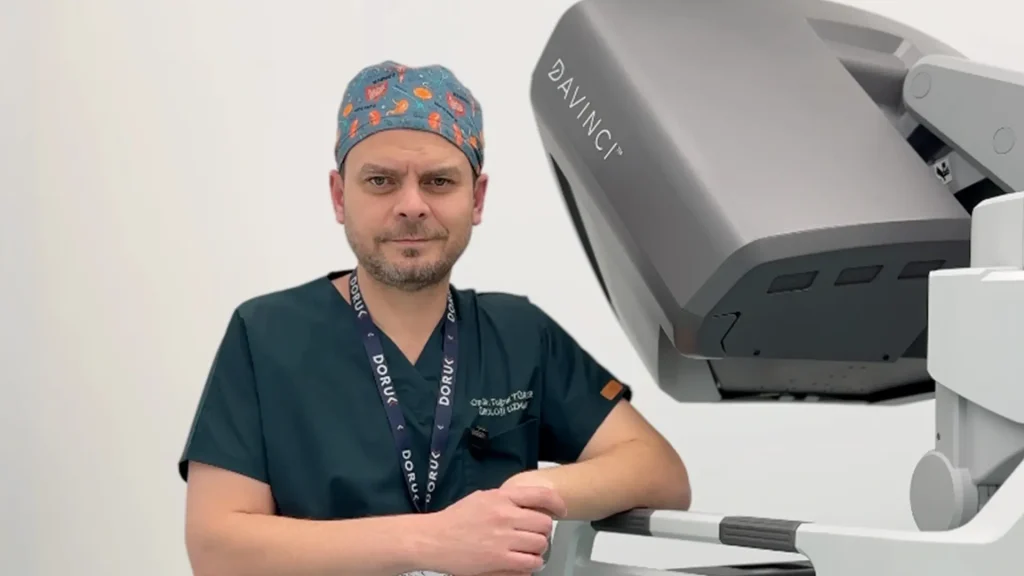
Table of Contents
ToggleWhat is kidney cancer?
Kidney cancer is a malignant tumor disease that occurs as a result of the uncontrolled proliferation of cells in the kidney tissue. These tumors, which normally develop in the kidneys, which are responsible for filtering waste materials and producing urine, may not show symptoms at an early stage and are usually detected incidentally during imaging for another reason.
The most common type of kidney cancer is renal cell carcinoma (RCC). Apart from this, there are rarer types such as urothelial carcinoma and Wilms tumor (the type seen in children).
What are the symptoms of kidney cancer?
Kidney cancer is a disease that usually does not show symptoms at an early stage . For this reason, most cases are detected incidentally during ultrasound or tomography performed for another reason. However, as the disease progresses, some noticeable symptoms may appear.
- Blood in the Urine (Hematuria)
- Pain in the Side or Back Area
- Palpable Mass in the Abdomen
- Loss of Appetite and Weight Loss
- Fever and Night Sweats
- Weakness and Anemia (Anemia)
- High Blood Pressure (Hypertension)
These symptoms may not be specific to kidney cancer alone. However, if there are such complaints, especially if blood is seen in the urine, it is necessary to consult a urologist immediately. Kidney cancer usually progresses silently in the early stages; Therefore, regular check-ups are very important for early diagnosis. When diagnosed early, treatment success and complete recovery rate are quite high.
What is robotic kidney cancer surgery?
Robotic kidney cancer surgery is a minimally invasive (closed) surgical method performed using the da Vinci robotic surgery system in the treatment of kidney tumors. This method not only provides the surgeon with exceptional vision and precision of movement, but also offers the patient less pain, small incisions and a fast recovery process.
In the da Vinci robotic system, the surgeon manages the robot’s arms from a control console. These robotic arms move much more precisely and without tremors than human hands, allowing the tumor tissue to be removed at the millimeter level . In addition, the surrounding healthy kidney tissue is preserved, which contributes to the continuation of kidney functions.
Robotic kidney cancer surgery is one of the most advanced and comfortable surgical methods offered by modern medicine. It both increases surgical success and allows patients to spend the postoperative period much more comfortably. For this reason, it has become one of the “gold standard” methods in the treatment of kidney cancer today.
What are the advantages of robotic kidney cancer surgery?
Robotic kidney cancer surgery is a high-precision and minimally invasive (closed) surgical method performed using the da Vinci robotic surgery system . This technology not only provides the surgeon with more control and field of vision, but also offers the patient a comfortable recovery process.
Less Pain and Quick Recovery with Small Incisions
In robotic surgery, surgery is performed with several small incisions. In this way, pain and scarring are minimal, patients get back on their feet in a short time and return to their daily lives quickly.
Less Blood Loss
Thanks to the millimeter movement capability of the robotic system, the vessels and surrounding tissues are meticulously protected. This, in turn, significantly reduces blood loss during surgery and can eliminate the need for blood transfusions.
Preserving Kidney Function
Robotic surgery provides a great advantage, especially in partial nephrectomy (kidney-sparing surgery) applications. Only the tumor part is removed, preserving healthy kidney tissue. Thus, the patient’s kidney functions continue at the highest possible level.
High Surgical Precision
The da Vinci robotic system works with a three-dimensional high-resolution image and robotic arms that eliminate hand shaking. This allows the surgical procedure to be performed without damaging the nerve and vascular structures around the tumor .
Reduced Risk of Complications and Infections
With small incisions and minimal tissue trauma, the risk of postoperative infection, bleeding, and complications related to wound healing is remarkably low.
Short Hospital Stay
After robotic surgery, patients are usually discharged within 1-2 days . The hospital stay is significantly shorter than open surgery.
Aesthetic Advantage
Since robotic surgery is performed with small incisions, there is very little visible scarring after surgery. This provides patients with advantages both aesthetically and psychologically.
How is robotic kidney cancer surgery performed?
Robotic kidney cancer surgery is a minimally invasive (closed) surgical method performed using the da Vinci robotic surgery system . Thanks to this system, the surgeon manages the robot arms with millimeter precision, accompanied by a high-resolution three-dimensional image. Thus, the tumor kidney tissue or only the part where the tumor is located is removed with great care.
Postoperative Process
Patients are usually discharged within 1–2 days .
- Pain is minimal.
- Normal daily activities can be resumed within a few days.
- Heavy exercise and exertional activities should be avoided for the period recommended by the surgeon.
Robotic kidney cancer surgery is a modern treatment method that combines high technology, precision and patient comfort . Thanks to this surgery, which is performed with small incisions, patients have the advantage of much less pain, shorter recovery time and high success rate compared to open surgery.
Who is robotic kidney cancer surgery suitable for?
Robotic kidney cancer surgery is preferred as a minimally invasive (closed) method in the treatment of kidney tumors. This surgical approach ensures that both cancerous tissue is safely removed and healthy kidney tissue is preserved, especially in kidney cancers detected at an early stage .
However, not every patient may be suitable for this surgery. Suitability is evaluated by the urologist, taking into account the size, location, spread of the tumor and the general health status of the patient .
Early-Stage Kidney Cancer Patients
Robotic surgery is most preferred in organ-limited (early-stage) tumors that affect only a certain part of the kidney. In this way, the healthy part of the kidney can be preserved (partial nephrectomy).
Patients with Suitable General Health Status
Robotic surgery is performed under general anesthesia. Therefore, it is suitable for patients who do not have heart, lung or serious systemic conditions and have general health conditions suitable for surgery.
Patients Who Want to Preserve Kidney Function
In patients with a single kidney or limited kidney function, it is of great importance to remove only the tumor part instead of the entire kidney. Robotic surgery is an ideal method for this type of kidney-sparing surgery .
Patients Who Prefer Minimally Invasive Methods
Patients who want less pain, small incisions, short hospital stays, and quick recovery compared to open surgery benefit greatly from robotic surgery.
Patients at Low Risk of Recurrent Surgery
Robotic surgery gives the most effective results in limited cases where it is technically possible to reach the area where the tumor is located. Therefore, different surgical methods may be required in advanced stage tumors or tumors that have spread to surrounding tissues.
What is the recovery process like after robotic kidney cancer surgery?
Since robotic kidney cancer surgery is a minimally invasive (closed) method, the postoperative recovery process is usually much more comfortable, faster and smoother. Thanks to this surgery, which is performed with small incisions, patients can stand up and return to their daily lives in a short time.
- Post-surgery, patients usually stay in the hospital for 1 to 2 days . During this period, pain control is provided, urine output and kidney function are monitored.
- Since the incisions made in robotic surgery are very small, the pain level is minimal. Most patients recover comfortably with simple painkillers.
- Patients can usually return to their normal gait and light activities within a few days after surgery . For heavy physical activities, exercise, or driving, 2 –4 weeks of rest is generally recommended.
- Since small incisions are closed with aesthetic sutures, wound healing is rapid and there is usually no obvious scarring.
- In the postoperative period, patients’ kidney functions are checked regularly. Kidney functions are usually preserved in patients who undergo partial nephrectomy (kidney-sparing surgery).
- Drinking plenty of fluids and eating a balanced diet are important during the healing process. A diet is arranged in line with the doctor’s recommendations for the healthy functioning of the kidneys.
- Regular control examinations are performed in the postoperative period. The first check-up is usually within 1-2 weeks after surgery. Kidney functions and tumor monitoring are performed with imaging and blood tests .
- After robotic surgery, patients usually return to work and social life in a short time. The quality of life after surgery is high thanks to small incisions, little pain and quick recovery.
Frequently asked questions about robotic kidney cancer surgery
What is robotic kidney cancer surgery?
Robotic kidney surgery is a minimally invasive (closed) surgical method performed through small incisions with the da Vinci robotic surgery system . This system provides the surgeon with a three-dimensional image and high precision, allowing the tumor to be removed safely.
What is the difference between robotic surgery and open surgery?
While large incisions are made in open surgery, the procedure is performed with several small incisions in robotic surgery. This difference provides the patient with the advantage of less pain, short recovery time and minimal scarring .
How long does the surgery take?
Robotic kidney surgery usually takes between 2-4 hours . The duration may vary depending on the size and location of the tumor and the surgical technique.
How long do you stay in the hospital?
Most patients are discharged within 1–2 days after surgery. The hospital stay is quite short compared to open surgery.
Will there be pain after surgery?
Since the incisions made in robotic surgery are very small, the pain level is minimal. Most patients can control pain with simple painkillers.
Is the kidney completely removed?
This depends on the size and location of the tumor.
- If possible, only the tumor is removed and the rest of the kidney is preserved (partial nephrectomy).
- If there is a wide spread, the entire kidney can be removed (radical nephrectomy).
Will there be any scars after robotic surgery?
No, since the surgery is performed with a few small incisions, there is very little or almost invisible scarring in terms of aesthetics.
When can I return to normal life after surgery?
Patients can usually walk within a few days and return to normal activities within 1-2 weeks . It is recommended to avoid jobs that require heavy exercise or physical exertion for a few weeks.
Is robotic surgery safe?
Yes. The da Vinci robotic system is an FDA-approved and extremely safe technology that is used in thousands of successful surgeries around the world.
Can cancer recur after robotic surgery?
As with all types of cancer, the risk of recurrence depends on the stage and biological characteristics of the tumor. Possible recurrences can be detected at an early stage with regular check-ups and follow-up tests.
Will my kidney functions be preserved after robotic surgery?
Yes. Especially in patients who have undergone partial (kidney-sparing) surgery, healthy kidney tissue is preserved and kidney functions continue to a large extent.