
Robotic surgery in Bursa is a modern surgical method that offers high precision and a minimally invasive approach to the treatment of urological diseases. Op. Dr. Dr. Tuğrul Türker performs robot-assisted surgical applications in advanced urological diseases such as prostate cancer, kidney tumors and bladder cancer within the scope of robotic surgery in Bursa.
Robotic surgery in urology is a minimally invasive (closed) surgical method performed using the Da Vinci robotic surgery system. This advanced technology system provides the surgeon with a three-dimensional high-resolution image and millimeter precision. Thus, nerves, vessels and surrounding tissues can be protected more safely during the operation.
Robotic surgery is performed with much smaller incisions compared to traditional open surgery. This provides important advantages such as less pain, shorter hospital stay, minimal scarring, and faster recovery for patients.
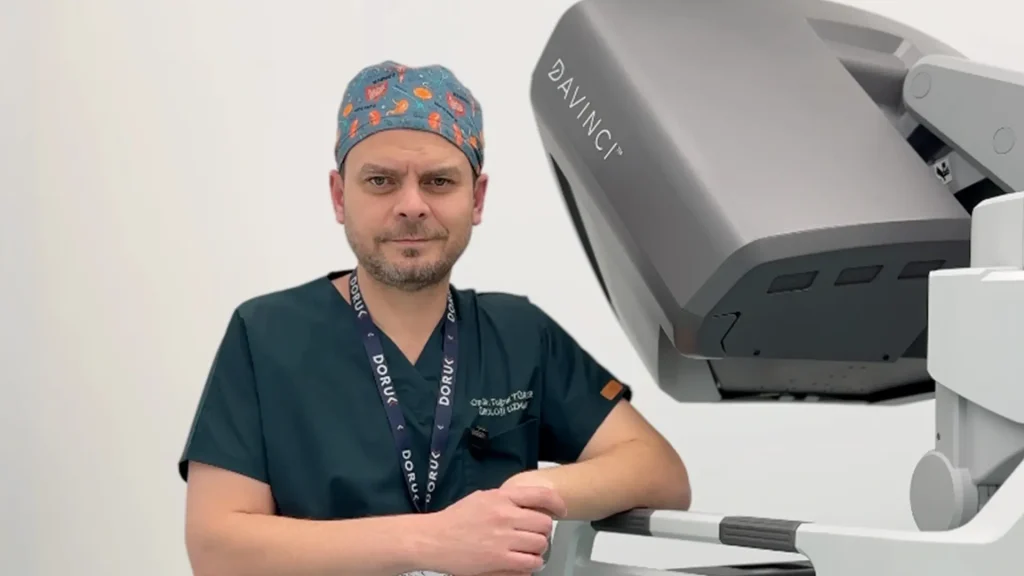
Table of Contents
ToggleWhat is Da Vinci surgery?
The Da Vinci robotic surgical system is one of the most advanced surgical technologies in modern medicine. This system provides the surgeon with three-dimensional, high-resolution imaging and millimetric movement precision during surgery, enabling safe, effective, and minimally invasive (laparoscopic) operations.
Da Vinci surgery is named after the famous scientist Leonardo da Vinci, as the system’s foundation incorporates traces of his studies on anatomy and mechanics.
In this surgical method, the operation is controlled by the surgeon, not the robot. The surgeon controls the robotic arms through a special console. These robotic arms can move much more precisely and without tremor than the human hand. This allows surgical procedures to be performed very safely even in narrow and sensitive areas of the body.
Key features of Da Vinci surgery
- Clear surgical field visibility with three-dimensional and high-resolution imaging
- Robotic arms with millimetric and tremor-free movement
- High-precision surgery under complete surgeon control
- Minimally invasive (laparoscopic) surgical approach with small incisions
What are the main areas where robotic surgery is applied in Bursa?
The Da Vinci robotic surgical system is one of the most widely used advanced surgical technologies in urology.
By providing the surgeon with three-dimensional magnified imaging and millimetric movement precision, it enables complex surgeries to be performed safely, effectively, and minimally invasively (laparoscopically).
Thanks to this system, patients experience a comfortable treatment process with less pain, shorter recovery time, and minimal scarring.
Robotic Prostate Cancer Surgery (Robotic Radical Prostatectomy)
This is the most commonly used robotic surgical application in prostate cancer treatment.
- The prostate gland is removed with high precision.
- Thanks to nerve-sparing techniques, urinary control (continence) and sexual functions can be largely preserved.
- Provides less blood loss and faster recovery compared to open surgery.
Robotic Kidney Cancer Surgery (Robotic Nephrectomy / Partial Nephrectomy)
Used in the treatment of kidney tumors.
- Either the entire kidney (radical nephrectomy) or just the tumorous part (partial nephrectomy) can be removed.
- Healthy kidney tissue is preserved.
- Offers high success rate with less blood loss and short hospital stay.
Robotic Bladder Cancer Surgery (Robotic Radical Cystectomy)
Applied in advanced stages of bladder cancer.
- The bladder is removed completely or partially.
- When necessary, a new bladder (neobladder) can be created from intestinal tissue.
- Provides advantages of small incisions, low pain levels, and rapid recovery.
Robotic Ureter Surgery
Applied in ureter (urinary tract) strictures, tumors, or injuries.
- The narrow or damaged area is repaired thanks to the high precision of the robotic system.
- Urine flow returns to normal, kidney function is preserved.
Robotic Pyeloplasty (Kidney Pelvis Stricture Repair)
Used in the treatment of strictures between the kidney and urinary tract (UPJ stricture).
- Normalizes urine flow while preserving kidney functions.
- Has high success rates especially in young patients.
Robotic Lymph Node Dissection
In cases such as prostate or testicular cancer, lymph nodes can be safely removed using the robotic system to check for tumor spread.
Da Vinci robotic surgery is safely used in treating many diseases related to the prostate, kidney, bladder, and urinary tract in urology. While providing superior vision and control to the surgeon, it offers patients less pain, shorter recovery time, and higher quality of life. Therefore, it is considered one of the most advanced and effective methods of modern technology in urological surgery today.
What are the differences between Da Vinci robotic surgery and laparoscopy?
Both Da Vinci robotic surgery and laparoscopic surgery are minimally invasive surgical methods that offer advantages of less pain, smaller incisions, and faster recovery compared to open surgery.
However, the da Vinci robotic system has much more advanced technology and surgical control precision compared to laparoscopy.
Surgeon’s Control Method
- Laparoscopy: The surgeon directly uses long, thin surgical instruments with their hands. The instruments have limited movement capability.
- Da Vinci Robotic Surgery: The surgeon controls the surgery from a special console. Robotic arms mimic the surgeon’s hand movements at a millimetric level — even more precisely and without tremor than the human hand.
Image Quality and Depth Perception
- Laparoscopy: Works with a two-dimensional (2D) camera system. Depth perception is limited.
- Da Vinci Robotic Surgery: Provides three-dimensional (3D) and high-resolution imaging. The surgeon sees the surgical field magnified and with depth.
Instrument Movement Capability
- Laparoscopy: The instrument tips can only rotate at certain angles. This creates limitations in complex areas.
- Da Vinci Robotic Surgery: Robotic arms have a wider range of motion (540°) than the human wrist. This allows perfect maneuverability even in narrow and difficult areas.
Hand Tremor and Stability
- Laparoscopy: The surgeon’s hand tremor can directly affect the instruments.
- Da Vinci Robotic Surgery: The robotic system completely eliminates hand tremor.
Surgeon’s Ergonomics and Comfort
- Laparoscopy: The surgeon stands and may experience physical fatigue during long operations while directly using the instruments.
- Da Vinci Robotic Surgery: The surgeon works sitting at an ergonomic console, allowing for more comfortable and focused performance even during long surgeries.
Advantages for Patients
While both methods are advantageous compared to open surgery, robotic surgery offers patients:
- Less pain
- Shorter hospital stay
- Faster recovery and return to work
- Smaller surgical scars
- Lower risk of complications.
What are the advantages of Da Vinci robotic surgery compared to open surgery?
The Da Vinci robotic surgical system is one of the most advanced surgical technologies in modern medicine.
While open surgeries require large incisions, robotic surgery only needs a few small incisions. This increases surgical precision and allows the patient to experience a much faster and more comfortable recovery process.
Small Incisions – Less Tissue Damage
While open surgery requires large incisions, da Vinci robotic surgery uses only a few small incisions.
- Less pain,
- Less blood loss,
- Smaller scars, and
- Faster wound healing.
Less Pain and Rapid Recovery
Due to small incisions and minimal tissue trauma, post-operative pain is significantly reduced.
Patients can get back on their feet much sooner and return to their daily lives compared to open surgery.
Less Blood Loss and Lower Complication Risk
Thanks to the millimetric precision of the Da Vinci robotic system, blood vessels are carefully preserved.
- Blood loss is minimal,
- Need for blood transfusion is reduced,
- Risk of infection and complications is lower.
High Surgical Precision and Clear Field of Vision
The robotic system provides the surgeon with three-dimensional high-resolution imaging and tremor-free robotic arms.
Thanks to this technology:
- The surgeon can see the operation field magnified up to 10 times.
- Nerves, vessels, and organs can be preserved with millimetric precision movements.
Shorter Hospital Stay
While patients typically stay in the hospital for 5-7 days after open surgery, this period is often reduced to 1-2 days after robotic surgery.
This both increases patient comfort and reduces infection risk.
Aesthetic Advantage – Minimal Scarring
Since robotic surgery is performed with small incisions, it leaves much less and more aesthetic scarring after surgery.
This is particularly important psychological and cosmetic advantage for young patients.
Nerve and Function Preservation Capabilities
The Da Vinci system provides great advantage in preserving nerves around sensitive organs like prostate, kidney, and bladder.
- Urinary control (continence) and
- Sexual functions are preserved at much higher rates compared to open surgery.
Faster Return to Social and Work Life
Since the recovery process after robotic surgery is short, patients can return to their work and social lives weeks earlier compared to open surgery.
Da Vinci robotic surgery offers many advantages compared to open surgery, such as smaller incisions, less pain, faster recovery, and higher surgical precision. These features provide patients with a more comfortable surgical experience and shorter recovery period. Today, robotic surgery, especially in urology, is considered one of the safest and most effective surgical methods of modern medicine.
Frequently asked questions about Da Vinci robotic surgery
Does the robot perform the surgery by itself?
No. The surgery is completely under the control of the surgeon. The robot transfers the surgeon’s hand movements to the surgical area at the millimeter level and without vibration. In other words, “the robot does not operate on its own”; The surgeon manages the surgery through the robot.
What is the difference between robotic surgery and open surgery?
While open surgery requires large incisions, robotic surgery is performed with several small incisions.
- Less pain,
- Less blood loss,
- Shorter hospital stay, and
- Faster recovery are achieved.
Is robotic surgery safe?
Yes. The da Vinci system is a safe technology approved by the FDA (American Food and Drug Administration) that has been used in tens of thousands of successful surgeries around the world. The surgeon controls the system completely, the robot does not make its own decisions.
Will there be pain after surgery?
Thanks to small incisions, post-operative pain is very minimal. Most patients experience a comfortable recovery process with simple pain medications.
How long until discharge after robotic surgery?
While patients typically stay in the hospital for 5-7 days after open surgery, this period ranges from 1-3 days after robotic surgery.
Does robotic surgery leave scars?
No. Since the surgery is performed with small incisions, usually very minimal or barely noticeable scarring remains.
Is every patient suitable for robotic surgery?
Not every patient is suitable for robotic surgery. Suitability is evaluated by the surgeon considering the type and stage of the disease and the patient’s general health condition.
Is robotic surgery more expensive?
Yes, because the robotic system contains advanced technology, its cost is slightly higher than classical surgery.
However, the overall treatment cost may be lower due to shorter hospital stay, lower complication rate, and faster recovery advantages.
How successful is robotic surgery?
Da Vinci robotic surgery increases surgical success thanks to the high control and vision it provides to the surgeon. It delivers equivalent or superior results compared to open surgery, especially in sensitive areas such as prostate, kidney, and bladder cancer.