
Robotic bladder cancer surgery is a minimally invasive (closed) surgical method performed using the da Vinci robotic surgery system. This advanced technology offers the surgeon the opportunity to work with three-dimensional high-resolution imaging, tremor filtration and millimeter precision. Thus, while the cancerous bladder tissue is safely removed in accordance with oncological principles, it is aimed to protect the surrounding healthy organs and tissues.
Robotic bladder cancer surgery in Bursa is successfully performed, especially in radical cystectomy (complete removal of the bladder) and the creation of a new bladder (neobladder) in suitable patients. Thanks to these technical advantages offered by robotic surgery, less bleeding, shorter hospital stay and faster recovery process can be achieved.
Robotic bladder cancer surgery prices and surgical method to be applied; It is determined after the examination according to the stage of the disease, its spread, the general health status of the patient and the planned surgical technique. For detailed information and to make an appointment, you can contact us from the contact options below.
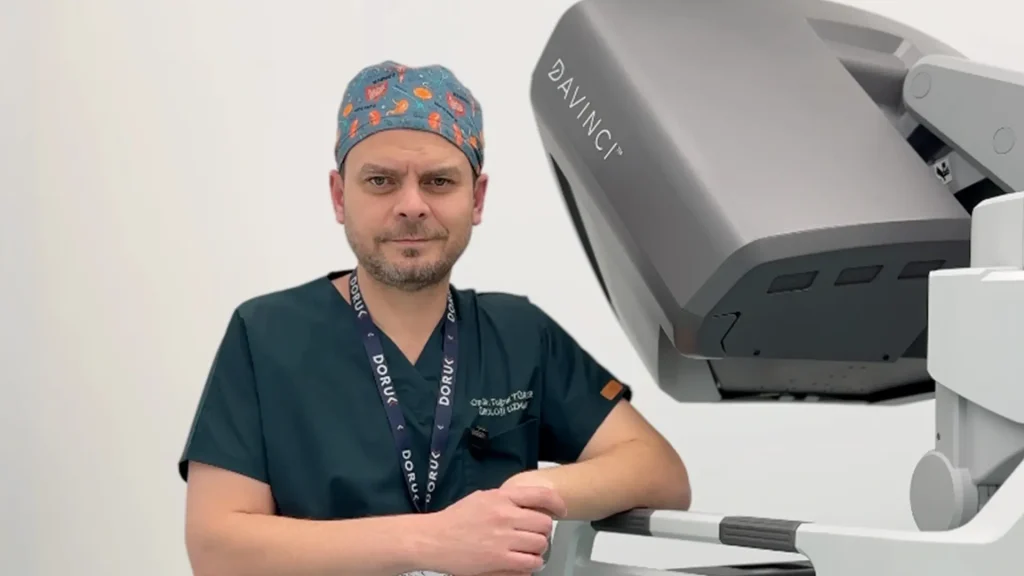
Table of Contents
ToggleWhat is bladder cancer?
Bladder cancer is a malignant tumor disease that occurs as a result of the uncontrolled proliferation of cells lining the inner surface of the bladder, the organ where urine is stored. The most common type is urothelial (transitional cell) carcinoma. This cancer usually starts in the lining of the bladder and can be completely eliminated with treatment if detected early.
Bladder cancer often goes unnoticed at an early stage, but the following symptoms may appear:
- Blood in the urine (hematuria): It is the most common symptom. The urine may be pink, red, or brown.
- Frequent urination
- Burning or pain when urinating
- Pain in the lower abdomen or lumbar region
- In advanced stages, weakness, weight loss, loss of appetite
Bladder cancer is a completely treatable disease when detected early. Warning symptoms such as blood in the urine should not be ignored, and regular urological check-ups should not be neglected. Early diagnosis significantly improves both treatment success and quality of life.
What is robotic bladder cancer surgery?
Robotic bladder cancer surgery is a minimally invasive (closed) surgical method performed through the da Vinci robotic surgery system used in the treatment of bladder cancer. Thanks to this advanced technology, the surgeon can perform the surgery under a three-dimensional high-resolution image and with millimeter precision.
Robotic surgery provides a great advantage, especially in surgeries called radical cystectomy , where the bladder is completely removed. If necessary, a new bladder (neobladder) can be created from the patient’s own intestinal tissue. In this way, both the cancerous tissue is completely cleaned and the patient’s urination function can be preserved.
What is robotic kidney cancer surgery?
Robotic kidney cancer surgery is a minimally invasive (closed) surgical method performed using the da Vinci robotic surgery system in the treatment of kidney tumors. This method not only provides the surgeon with exceptional vision and precision of movement, but also offers the patient less pain, small incisions and a fast recovery process.
In the da Vinci robotic system, the surgeon manages the robot’s arms from a control console. These robotic arms move much more precisely and without tremors than human hands, allowing the tumor tissue to be removed at the millimeter level . In addition, the surrounding healthy kidney tissue is preserved, which contributes to the continuation of kidney functions.
Robotic kidney cancer surgery is one of the most advanced and comfortable surgical methods offered by modern medicine. It both increases surgical success and allows patients to spend the postoperative period much more comfortably. For this reason, it has become one of the “gold standard” methods in the treatment of kidney cancer today.
What are the advantages of robotic bladder cancer surgery?
Robotic bladder cancer surgery is a minimally invasive (closed) surgical method performed using the da Vinci robotic surgery system. This technology provides the surgeon with a three-dimensional magnified image and millimeter precision during surgery; Thus, both the success of the surgery and patient comfort increase significantly.
This method, which offers numerous advantages over open surgery, has become one of the gold standards of modern surgery in the treatment of bladder cancer today.
Small Incisions, Less Pain, and Quick Recovery
Robotic surgery is performed through several small incisions. In this way, postoperative pain is much less, wound healing is accelerated and the patient can return to his daily life in a short time.
Less Blood Loss
With precise surgical control provided by the robotic system, blood loss during surgery is minimal. This both increases safety and speeds up the healing process.
Short Hospital Stay
With small incisions and minimal tissue trauma, patients are typically discharged within 1–2 days . Compared to open surgery, the hospital stay is significantly shortened.
High Surgical Precision and Quality of Vision
The da Vinci system provides the surgeon with a 3D high-resolution image . The vibration-free and flexible mobility of the robotic arms allows surgery to be performed without damaging nerve and vascular structures.
Urinary Control and Protection of Sexual Functions
Thanks to the precision provided by robotic surgery, the nerves around the bladder can be preserved. This contributes to faster recovery of urinary control and sexual functions after surgery.
Low Risk of Complications and Infections
Thanks to the minimally invasive approach, complications such as postoperative infection, bleeding and wound dehiscence are much rarer than open surgery.
Aesthetic Advantage
The small incisions made in robotic surgery leave much smaller scars than the large incisions in open surgery. This provides advantages for patients both aesthetically and psychologically.
How is robotic bladder cancer surgery performed?
Robotic bladder cancer surgery is a minimally invasive (closed) surgical method performed using the da Vinci robotic surgery system. This system offers the surgeon the opportunity to move with a three-dimensional magnified image and millimeter precision. Thus, both the cancerous bladder tissue is safely removed and the surrounding healthy structures are preserved.
Robotic surgery is usually performed in operations called radical cystectomy , in which the bladder is completely removed. If necessary, a new bladder (neobladder) can be created from intestinal tissue to preserve the patient’s natural urination function.
Robotic bladder cancer surgery is a modern treatment method that combines high technology, surgical precision and patient comfort . With advantages such as small incisions, less pain, short hospital stay and faster recovery, it offers a much safer and more comfortable alternative to open surgery in the treatment of bladder cancer.
Who is robotic bladder cancer surgery suitable for?
Robotic bladder cancer surgery is a high-precision and minimally invasive (closed) surgical method performed with the da Vinci robotic surgery system . This method is especially preferred in invasive cancers that have progressed to the muscle layer of the bladder and in cases where the bladder needs to be completely removed.
However, not every patient may be suitable for this surgery. Suitability is evaluated by the urologist, taking into account the stage of the tumor, the patient’s general health status, age and postoperative functional expectations .
Patients with Muscle Invasive Bladder Cancer
Robotic surgery is usually performed in patients who have advanced to the muscle tissue of the bladder and require radical cystectomy (complete removal of the bladder). In this way, the cancerous tissue can be completely cleaned.
Patients with General Health Status Suitable for Surgery
Robotic surgery is performed under general anesthesia . For this reason, patients who do not have heart, lung or serious systemic diseases and whose general health condition is suitable are candidates for this surgery.
Patients Who Want to Benefit from the Minimally Invasive Method
Robotic surgery provides significant advantages for patients who want less pain, small incisions, low blood loss, and rapid recovery compared to open surgery.
Patients with New Bladder (Neobladder) Eligibility
In some patients whose bladder has been removed, a new bladder (neobladder) can be created from intestinal tissue. Robotic surgery allows this procedure to be performed more precisely and anatomically correctly.
Patients Who Are Not Advanced and Have High Recovery Potential
Robotic surgery is advantageous in terms of tissue healing and postoperative rehabilitation process. Therefore, it is ideal for patients who can actively complete the postoperative process.
Patients Who Have Not Had Prior Radiotherapy or Major Pelvic Surgery
Robotic surgery can be performed more safely and effectively in patients who do not have dense adhesions or radiation damage in the pelvic area.
Recovery process after robotic bladder cancer surgery
Since robotic bladder cancer surgery is a minimally invasive (closed) method performed with the da Vinci robotic system , the postoperative recovery process is usually fast, comfortable and without complications . This operation, performed with small incisions, both reduces pain and allows patients to return to their normal lives in a short time.
Length of Hospital Stay
After robotic surgery, patients usually stay in the hospital for 3-5 days .
During this time:
- Pain control is provided,
- The functions of the bladder or the newly created bladder (neobladder) are monitored,
- Nutrition and fluid intake are started gradually.
The hospital stay is noticeably shorter compared to open surgery.
Postoperative Pain and Discomfort
Since robotic surgery is performed with small incisions, the pain level is minimal. Most patients recover comfortably with simple painkillers.
The low pain facilitates early mobilization (walking and moving), which speeds up recovery.
Return to Daily Life
Patients can usually return to their normal life activities 2-3 weeks after surgery . For heavy physical activities or exercises, it is necessary to wait 4-6 weeks according to the doctor’s recommendation.
Urinary Control and New Bladder Adaptation
If a new bladder (neobladder) was created during surgery, it may take several weeks for the patient to adapt to this new structure.
- Initially, urinary control may not be complete, but over time, the muscles become stronger.
- Pelvic floor exercises recommended by the doctor (e.g. Kegel exercises) speed up this process.
Nutrition and Daily Habits
In the postoperative period:
- For the first few days, you start with liquid foods, then switch to a normal diet.
- Drinking plenty of water is important for the healthy functioning of the kidneys and urinary tract.
Monitoring and Controls
Patients are called for check-ups at regular intervals after discharge.
- The first check-up is usually done 1-2 weeks after surgery.
- Blood tests, imaging and urine analysis evaluate kidney function and the condition of the new bladder.
Frequently asked questions about robotic bladder cancer surgery
What is the difference between robotic surgery and open surgery?
While large incisions are made in open surgery, a few small incisions are sufficient in robotic surgery. This difference gives the patient the advantage of less pain, less blood loss, short hospital stay, and faster recovery .
How long does the surgery take?
Robotic bladder surgery usually takes between 4-6 hours . This period may vary depending on the size and spread of the tumor and the patient-specific surgical procedures (e.g., creating a new bladder).
Is the bladder completely removed?
Yes, the bladder is usually completely removed through a procedure called a radical cystectomy . However, in some early-stage cases, partial cystectomy may be performed, in which only the tumor part is removed.
How to urinate after surgery?
When the bladder is removed, a new bladder (neobladder) or bladder (ileal conduit) is created from the intestinal tissue. In this way, the patient can urinate normally or through the bag.
Will there be pain after surgery?
No, robotic surgery is performed through small incisions, so the pain is minimal. Most patients recover comfortably with simple painkillers.
How long do you stay in the hospital?
After robotic surgery, patients are usually discharged within 3-5 days . This period is quite short compared to open surgery.
When can I return to normal life after surgery?
Patients can usually return to their daily activities within 2-4 weeks . It is recommended to wait a few more weeks for heavy physical exercises.
Is robotic surgery safe?
Yes. The da Vinci robotic surgery system is an advanced technology with proven safety that has been used in thousands of successful surgeries around the world. The surgeon directly controls the entire process; The robot does not move independently.
Are sexual functions preserved after surgery?
Robotic surgery allows nerve-sparing techniques to be applied precisely. In this way, sexual functions and urinary control can recover faster than open surgery.
Can cancer recur?
As with any type of cancer, the risk of recurrence depends on the stage and type of tumor, as well as the patient’s overall condition. Regular check-ups are of great importance for early detection.
Will there be any scars after robotic surgery?
No, since the surgery is performed with small incisions, there is little or almost invisible scarring in terms of aesthetics.